
It was only in the 19th century that alternatives to Euclidean geometry appeared. What was to be respected as the most basic geometry for the physical sciences: Euclidean, non-Euclidean with constant curvature, projective? Frege, Poincare, Russell, and Whitehead were, to various degrees, on the conservative side on this question.>[1]
In the 20th, alternatives to classical logic appeared, even as it was being created in its present form. First Intuitionistic logic, then quantum logic, and then relevant and paraconsistent logics, each with a special claim be more basic, more general in its applicability, than classical logic.
Conservative voices were certainly heard. John Burgess told his seminars “Heretics in logic should be hissed away!”. David Lewis described relevant and paraconsistent logic as logic for equivocators. The other side was not quiet. Just as Hans Reichenbach gave a story of coherent experience in a non-Euclidean space, so Graham Priest wrote a story of characters remaining seemingly coherent throughout a self-contradictory experience.
Unlike in the case of Euclidean geometry, the alternatives offered for propositional logic have all been weaker than classical logic. So how weak can we go? What is weaker, but still sufficiently strong, to qualify as “the” logic, logic simpliciter?
I am very attracted to the idea that a certain subclassical logic (FDE) has a better claim than classical logic to be “the” logic, the most basic logic. It is well studied, and would be quite easy to teach as a first logic class. Beall (2018) provides relevant arguments here – the arguments are substantial, and deserve discussion. But I propose to reflect on what the question involves, how it is to be understood, from my own point of view, to say why I find FDE attractive, and what open questions I still have.
1. A case for FDE
The question what is the most basic logic sounds factual, but I cannot see how it could be. However, a normative claim of the form
Logic L is the weakest logic to be respected in the formulation of empirical or abstract theories
seems to make good sense. We had the historical precedent of Hilary Putnam’s claiming this for quantum logic. I will come back to that claim below, but I see good reasons to say that FDE is a much better candidate.
2. Starting a case for FDE
FDE has no theorems. FDE is just the FDE consequence relation, the relation originally called tautological entailment, and FDE recognizes no tautologies. Let us call a logic truly simple if it has no theorems.
To be clear: I take L to be a logic only if it is a closure operator on the set of sentences of a particular syntax. The members of L(X) are the consequences of X in L, or the L-consequences of X; they are also called the sentences that X entails in L. A sentence A is a theorem of L iff A is a member of L(X) for all X. The reason why FDE has no theorems is that it meets the variable-sharing requirement: that is to say, B is an L-consequence of A only there is an atomic sentence that is a component of both B and A.
So the initial case for FDE can be this: it is truly simple, as it must be, because
logic does not bring us truths, it is the neutral arbiter for reasoning and argumentation, and supplies no answers of its own.
To assess this case we need a clear notion of what counts as a logic (beyond its being a closure operator), and what counts as supplying answers. If I answered someone’s question with “Maybe so and maybe not”, she might well say that I have not told her anything. But is that literally true? A. N. Prior once made a little joke, “What’s all the fuss about Excluded Middle? Either it is true or it is not!”. We would have laughed less if there had been no Intuitionistic logic.
3. Allowance for pluralism
My colleague Mark Johnston like to say that the big lesson of 20th century philosophy was that nothing reduces to anything else. In philosophy of science pluralism, the denial that for every scientific theory there is a reduction to physics, has been having a good deal of play.
As I mentioned, FDE’s notable feature is the variable-sharing condition for entailment. If A and B have no atomic sentences in common, then A does not entail B in FDE. So to formulate two theories that are logically entirely independent, choose two disjoint subsets of the atomic sentences of the language. Within FDE, theories which are formulated in the resulting disjoint sublanguages will lack any connection whatsoever.
4. Could FDE be a little too weak?
The most conservative extension, it seems to me, would be to add the falsum, ⊥. It’s a common impression that adding this as a logical sign, with the stipulation that all sentences are consequences of ⊥, is cost-less.
But if we added it to FDE semantics with the stipulation that ⊥ is false and never true, on all interpretations, then we get a tautology after all: ~⊥. The corresponding logic, call it FDE+, then has ~ ⊥ as a theorem. So FDE+ is not truly simple, it fails the above criterion for being “the” logic. Despite that common impression, it is stronger than FDE, although the addition looks at once minimal and important. Is FDE missing out on too much?
How should we think of FDE+?
Option one is to say that ⊥, a propositional constant, is a substantive statement, that adding it is like adding “Snow is white”, so its addition is simply the creation of a theory of FDE.
Option two is to say that FDE+ is a mixed logic, not a pure logic. The criterion I would propose for this option is this:
A logic L defined on a syntax X is pure if and only if every syntactic category except that of the syncategoremata (the logical and punctuation signs) is subject to the rule of substitution.
So for example, in FDE the only relevant category is the sentences, and if any premises X entails A, in FDE, then any systematic substitution of sentences for atomic sentences in X entails the corresponding substitution in A.
But in FDE+ substitution for atomic sentence ⊥ does not preserve entailment in general. Hence FDE is a pure logic, and FDE+ is not.
The two options are not exclusive. By the usual definition, a theory of logic L is a set of sentences closed under entailment in L. So the set of theorems of FDE+ is a theory of FDE. However, it is a theory of a very special sort, not like the sort of theory that takes the third atomic sentence (which happens to be “Snow is white”) as its axiom.
Open question: how could we spell out this difference between these two sorts of theories?
5. Might FDE be too strong?
FDE is weak compared to classical logic, but not very weak. What about challenges to FDE as too strong?
It seems to me that any response to such a challenge would have be to argue that a notion of consequence weaker than FDE would be at best a closure operator of logical interest. But the distinction cannot be empty or a matter of fiat.
Distributivity
The first challenge to classical logic that is also a challenge to FDE came from Birkhoff and von Neumann, and was to distributivity. They introduced quantum logic, and at one point Hilary Putnam championed that as candidate for “the” logic. Putnam’s arguments did not fare well.[2]
But there are simpler examples that mimic quantum logic in the relevant respect.
Logic of approximate value-attributions
Let the propositions (which sentences can take as semantic content) be the couples [m, E], with E an interval of real numbers – to be read as “the quantity in question (m) has a value in E”.
The empty set 𝜙 is counted as an interval. The operations on these propositions are defined:
[m, E] ∧ [m, F] = [m, E ∩ F]
[m, E] v [m, F] = [m, E Θ F],
where E Θ F the least interval that contains E ∪ F
Then if E, F, G are the disjoint intervals (0.3, 0.7), [0, 0.3], and [0.7, 1],
[m, E] ∧ ([m, F] v [m, G]) = [m, E] ∧ ([ m, [0,1]] = [m, E]
([m, E] ∧ ([m, F]) v ([m, E] ∧ ([m, G]) = [m, 𝜙]
which violates distributivity.
This looks like a good challenge to distributivity if the little language I described is a good part of our natural language, and if it can be said to have a logic of its own.
The open question:
if we can isolate any identifiable fragment of natural language and show that taken in and by itself, it has a logical structure that violates a certain principle, must “the” logic, the basic logic, then lack that principle?
Closure and conflict
We get a different, more radical, challenge from deontic logic. In certain deontic logics there is allowance for conflicting obligations. Suppose an agent is obliged to do X and also obliged to refrain from doing X, for reasons that cannot be reconciled. By what logical principles do these obligations imply further obligations? At first blush, if doing X requires doing something else, then he is obliged to do that as well, and similarly for what ~X requires. But he cannot be obliged to both do and refrain from doing X: ought implies can.
Accordingly, Ali Farjami introduced the Up operator. It is defined parasitic on classical logic: a set X is closed under Up exactly if X contains the classical logical consequences of each of its members. For such an agent, caught up in moral conflict, the set of obligations he has is Up-closed, but not classical-logic closed.
If we took Up to be a logic, then it would be a logic in which premises A, B do not entail (A & B). Thus FDE has a principle which is violated in this context.
To head off this challenge one reposte might be that in deontic logic this sort of logical closure applies within the scope of a prefix. The analogy to draw on may be with prefixes like “In Greek mythology …”, “In Heinlein’s All You Zombies …”.
Another reposte can be that FDE offers its own response to the person in irresolvable moral conflict. He could accept that the set of statements A such that he is obliged to see to it that A, is an FDE theory, not a classical theory. Then he could say: “I am obliged to see to it that A, and also that ~A, and also that (A & ~A). But that does not mean that anything goes, I have landed in a moral conflict, but not in a moral black hole.”
Deontic logic and motivation from ethical dilemmas only provide the origin for the challenge, and may be disputed. Those aside, we still have a challenge to meet.
We have here another departure from both classical logic and FDE in and identifiable fragment of natural language. So we have to consider the challenge abstractly as well. And it can be applied directly to FDE.
Up is a closure operator on sets of sentences, just as is any logic. Indeed, if C is any closure operator on sets of sentences then the operator
Cu: Cu(X) = ∪{C({A}): A in X}
is also a closure operator thereon. (See Appendix.)
So we can also ask about FDEu. Is it a better candidate to be “the” logic?
FDEu is weaker than FDE, and it is both pure and truly simple. But it sounds outrageous, that logic should lack the rule of conjunction introduction!
6. Coda
We could give up and just say: for any language game that could be played there is a logic – that is all.
But a normative claim of form
Logic L is the weakest logic to be respected in the formulation of empirical or abstract theories
refers to things of real life importance. We are not talking about just any language game.
Last open question: if we focus on the general concept of empirical and abstract theories, can we find constraints on how strong that weakest logic has to be?
FDE is both pure and truly simple. Among the well-worked out, well studied, and widely applicable logics that we already have, it is the only one that is both pure and truly simple. That is the best case I can make for it so far.
7. APPENDIX
An operator C on a set X is a closure operator iff it maps subsets of X to subsets of X such that:
- X ⊆ C(X)
- CC(X) = C(X)
- If X ⊆ Y then C(X) ⊆ C(Y)
Definition. Cu(X) = ∪{C({A}): A in X}.
Proof that Cu is a closure operator:
- X ⊆ Cu(X). For if A is in X, then A is in C({A}), hence in Cu(X).
- CuCu (X) = Cu(X). Right to left follows from the preceding. Suppose A is in CuCu (X). Then there is a member B of Cu(X) such that A is in C({B}), and a member E of X such that B is in C({E}). Therefore A is in CC({E}). But CC({E}) = C({E}), so A is in Cu(X).
- If X ⊆ Y then Cu(X) ⊆ Cu(Y). For suppose X ⊆ Y. Then {C({A}): A in X} ⊆ {C({A}): A in Y}, so Cu(X) ⊆ Cu(Y).
8. REFERENCES
Beall, Jc. (2018) “The Simple Argument for Subclassical Logic”. Philosophical Issues.
Cook, Roy T. (2018) “Logic, Counterexamples, and Translation”. Pp. 17- 43 in Geoffrey Hellman and Roy T. Cook (Eds.) (2018) Hilary Putnam on Logic and Mathematics. Springer.
Hellman, Geoffrey (1980). “Quantum logic and meaning”. Proceedings of the Philosophy of Science Association 2: 493–511.
Putnam, Hilary (1968) “Is Logic Empirical” Pp. 216-241 in Cohen, R. and Wartofsky, M. (Eds.). (1968). Boston studies in the philosophy of science (Vol. 5). Dordrecht. Reprinted as “The logic of quantum mechanics”. Pp. 174–197 in Putnam, H. (1975). Mathematics, matter, and method: Philosophical papers (Vol. I). Cambridge.
Russell, Bertrand (1897) An Essay on the Foundations of Geometry. Cambridge.
NOTES
[1] For example, Russell concluded that the choice between Euclidean and non-Euclidean geometries is empirical, but spaces that lack constant curvature “we found logically unsound and impossible to know, and therefore to be condemned a priori (Russell 1897: 118).
[2] See Hellman (1980) and Cook (2018) especially for critical examination of Putnam’s argument.


 In the diagram K1 is the set of possible histories h1 and h2, and so CA(h1,t) = K1 = CA(h2, t). (Note well: I speak in terms of instants t of time, rather than Horty’s moments.
 In the first example the point made is that according to the above analysis, it is generally the case that the agent ought to gamble, since the best possible outcome is to win the gamble, and that is possible only if you gamble. That is implausible on the face of it — and in that first example, we see that the gambler could make sure that gets 5 units by not gambling, which looks like a better option than the gamble, which may end with a gain of 10 or nothing at all. While someone who values gambling for its own risk might agree, we can’t think that this is what he ought to do. The second example is the same except that winning the gamble would only bring 5 units, with a risk of getting 0, while not gambling brings 5 for sure. In this case we think that he definitely ought not to gamble, but on the above analysis it is not true either that he ought to gamble or ought not to gamble.
 Among the possible futures we have one that is actual, it is what will actually happen. This has been a subject of controversy; how could the following be true:
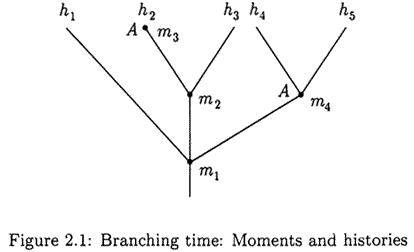 If h is in W and t in R then h(t) is the state of h at time t. Since many histories may intersect at time t, it is convenient to use an auxiliary notion: a moment is a pair <h, t> such that h(t) is the state of h at t.
  Bas van Fraassen's philosophy blog